Remembrance Day.

Originally called Armistice Day, this day commemorated the end of the hostilities for the Great War (World War I), the signing of the armistice, which occurred on 11 November 1918 – the 11th hour of the 11th day of the 11th month. Armistice Day was observed by the Allies as a way of remembering those who died, especially soldiers with ‘no known grave’.

On the first anniversary of the armistice, in 1919, one minute’s silence was instituted as part of the main commemorative ceremony. In London, in 1920, the commemoration was given added significance with the return of the remains of an unknown soldier from the battlefields of the Western Front.

The Flanders poppy became accepted throughout the allied nations as the flower of remembrance to be worn on Armistice Day. The red poppies were among the first plants that sprouted from the devastation of the battlefields of northern France and Belgium. ‘Soldiers’ folklore had it that the poppies were vivid red from having been nurtured in ground drenched with the blood of their comrades’.

Soldiers lost.

After the end of World War II in 1945, the Australian and British governments changed the name to Remembrance Day as an appropriate title for a day which would commemorate all war dead. In October 1997, then Governor-General of Australia, Sir William Deane, issued a proclamation declaring:

11 November as Remembrance Day and urging Australians to observe one minute’s silence at 11.00 am on Remembrance Day each year to remember the sacrifice of those who died or otherwise suffered in Australia’s cause in wars and war-like conflicts.

Taken from http://www.cultureandrecreation.gov.au/articles/remembrance/

So on this day of remembrance, I thought I would look into the lives of some famous war photographers. I suppose the name that comes to mind when i think of war photography is Robert Capa. Born in Budapest, Austria-Hungary in 1913, he was obviously to young to photograph the Great War, but is famous for his photos from the Spanish Civil war and WWII. He helped found Magnum Photos and is often quoted when people talk about street photography with this all to often heard quote.

“If your photographs aren’t good enough, you’re not close enough.”

It was in that terrific series, “The genius of photography“, that I first heard of Tony Vaccaro. He fought in the US Army and took his camera along. He talks about develpoing film in a helmet on a moonlit night during quiet times in the fighting. Certainly makes you think. I have troubles in my garage, and there is no chance of a bunch of Germans shooting at me through the window.

It really must take a ton of courage and a clear mind to take photos in times of war. So as well as remembering the soldiers today, I say we remember the photographers and journalists who reported on wars, and still do today.

Lest we forget.

Barack Obama, Canon and fanboys.

After spending a lot of my day at work watching the US election online and then witnessing some of the online discussions about the result, it got me wondering, “What makes people so passionate about their political views, religious beliefs and product loyalty?” Really, some of the tripe that I read about Obama winning the election was beyond belief. Ignorance is alive and well it seems. What drives people to hate the so called opposition in all aspects of life? I can, to a point, understand it in politics and religion, after all, they can have a profound effect on our lives. And I know that when I was younger, I was probably guilty of an intense dislike of people who didn’t agree with me, but these days I would like to think I am a little more tolerant of people with different beliefs to my own. Sure, I still find it hard how people can believe their lives are in some way controlled by a higher being, but I don’t hate them for it. As long as they don’t push their ideals on to me, I am fine with them having their beliefs.

Having pondered the political and religious idea for a few hours this afternoon, tonight it struck me. I was sitting, looking at where our kitchen used to be, will be again in a week or two, but isn’t at the moment, and it came like a bolt of lightning. People have the same fervent beliefs regarding products. You see it so often on internet forums, PC vs Mac, Intel vs AMD, Microsoft vs Apple and the list is longer than a politicians lunch. But what purpose does it serve? Do people really get such a kick out of bagging a product that they don’t use, and sometimes, have never used? Again, it wasn’t long ago that I was bagging Macintosh computers myself, and yet here I sit, plugging away happily on my 16 month old MacBook Pro. These days I wonder why I didn’t make the move years ago. I know it was because I used to play a lot of racing simulations that wouldn’t run on the Mac, but it doesn’t stop me thinking about it.

Fil-Lm

So we come to photography, after all, it is what this BLOG is supposed to be about. I saw a forum post today that went along the lines of…Anyone that uses a Nikon is a piss poor excuse for a photographer! What? I mean really, does the camera make that much difference? I would say no. This person had a link to their gallery in the forum signature, so I went off for a look at this Canon super photographer. To say I was under whelmed, well, is an understatement. Piss poor would best describe his photographic achievements. Now I am quite happy using a Canon camera, but if I won the lottery 3 months back, I would have traded the lot for a Nikon D3.

So help me understand this blind faith. Do you know of instances of it where you have read something on the net and shaken your head? Why do people need to degrade a person because of their product choice? Is it purely insecurity on their behalf? Its got me beat.

Is it too easy to take a good photo these days?

The aforementioned question popped into my head the other day whilst I was pouring over the Shorpy website, a fantastic site of old photos that have been digitised and retouched. You really need to have a look yourself to see how good these photos are. There really are some stunning photos on there. This shot for example, taken in 1947, over 60 years ago, is a beautiful photo. I don’t know if I could reproduce that image today. But I bet there are plenty of people who could.

And that brings me to the point of this BLOG entry. Is it too easy to take a good photo? Obviously, it isn’t, otherwise Flickr and sites like it would be loaded to the brim with magnificent images, and clearly, they are not. But I wonder what what the photographers of the mid 20th century think of the current day photo makers. Would they be sitting back in the recliners recalling the old days of large format cameras and lugging them 20 miles along a gravel road in bare feet just to get a shot. Not having the fancy exposure meters in todays cameras. The ability to chimp a shot, on the spot and retake it. The luxury of Photoshop compared to the dark room.

Where the photographers of days gone by better photographers than today? I hear names like Ansel Adams, Henri Cartier-Bresson, Garry Winogrand, Paul Strand and W. Eugene Smith and wonder how they would go with a nice new Nikon D3 and a few fancy lenses. Would Ansel Adams still take B&W landscapes? Or would they be colour rich ultra wide spectaculars?

I also wonder if they realise that their photos will be regarded as classics. Did Breson realise at the time that his photo of the man jumping a puddle would be a classic. Considering the man jumping the puddle was obviously still going to end up in the water, wouldn’t it have been better if the shot was slightly later, thus showing the man standing on water? Would that have changed peoples perception of the shot. After having heard some of the critics talk about the photo, I doubt it would have made any difference. Breson called it the decisive moment. I think it was a missed chance. Would he have taken a better photo with a Canon 1D MkIII firing away at 10 frames per second?

One thing that we can try is using older gear to take photos. I have already touched on that in the previous BLOG article, “Film, why is it so addictive?”. Using old equipment is one way to compare you photos from the older gear vs the newer gear.

There is no right answer to any of this, much like a lot of the previous BLOG entries. It is just a chance to discuss another aspect of a very interesting pass time, hobby or occupation. Feel free to discuss this. Suggest other photos or photographers. Have you tried to take photos with older gear? What was your experience?

Colour vs No Colour (color for the Americans out there).

Given the reaction to the previous few BLOG discussion topics, I expect this little collection of unstructured sentences, littered with spelling and grammatical inaccuracies, will generate its fair share of hysteria. Despite the fact that I am only trying to generate some interesting discussion on a few photography forums and Flickr discussion groups, it seems I have managed to piss a few people off. So be it. Im no stranger to a heated discussion. I have said before I love a passionate debate. And I have even had my mind changed by some of the discussion. Sit back down all you Strobists, I’m still an advocate of natural lighting, you haven’t swayed me yet.

Todays chatter is about black and white photography,(for those middle aged men with bushy beards and cardigans, please don’t take me to task over the fact that is should be duotone or some other term you have dragged out of “A pedants guide to correcting idiots.” I like to speak in simple terms)  and its reluctance to go the way of black and white TV. Black and white photography seems to be making a resurgance, I suspect, partly by people like myself diving into the non-digital (read, film) world of photography. Developing your own black and white film is cheap. Quite a bit cheaper once you are set up than taking the rolls to your local lab or chemist. But there is also an ever increasing crowd out there who are converting their colour images to black and white using Photoshop, GIMP and all the other virtual darkrooms available on the humble home computer. I used to poo-poo the idea, telling people if you can shoot colour, why go back to black and white. Animals see in black and white (I am too lazy to Google and see if that claim is 100% correct, so I am ready for the comments telling me I obviously didn’t see the NatGeo special on the  Pacific Blue Bearded Tit) and we see in colour. It might be why we are apex predators, who knows. I just know I used to like my photos in living colour, not some dreary black and white image. I think it was Dave Foley’s character in the terrific sitcom News radio who said something like “I find black and white photography pretentious”. I agreed, at the time.

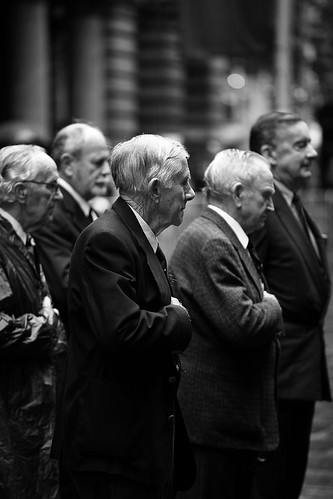
As it turns out, I must have magically evolved overnight quite a while back, because I can cope with a colour free photo these days. The odd one, not all photos. I even convert some of my own photos to black and white now. I really have no idea what photo I should convert to black and white, but it is usally a photo with a sombre mood, like this.

Remembering as a unit

Remembering as a unit

I can remember when I took it that that photo would brobably benefit from being processed as a black and white image. It happens on occasions. It might be that tiny part of my brain that houses the 3 synapses that make up my artistic side, the bit that I keep closed down for fear of my plums falling off. I have been told time and time again that there is some arty fartyness (if that doesn’t convince people there isn’t, nothing will) in me, and for the love of Mary’s young bloke, I wish they would stop.

So what I would like to know is why people embrace black and white photography with such gusto? I have heard things like tonal range, which makes as much sense to me as quantum physics to a 3 year old. Don’t get me wrong, I am not anti black and white, just curious as to why it is so much loved. I hold people like George Voulgaropoulos in the highest regard. His photos are amazing at times. And every now and them he takes them in colour too. Have a look at his work. Proof that that taking photos with out colour is the new black, and white!

Film, why is it so addictive?

Let me begin with a photo.

1st Frame of my 1st film developed right here at home.

That photo was the 1st photo on the 1st roll of film I developed myself. It was surprisingly easy to do, except the bit where you have to get the film out of the canister and onto a spool and into the light proof tank, all in the dark! But the developing itself was a doddle. Pour some liquids into a tank for a certain amount of time. Agitate a few times. Tip out. Done. Well, there is a little more to it than that, but its not hard. When the 1st negatives where hanging up to dry, I was as excited as a Strobist at a flash give away!

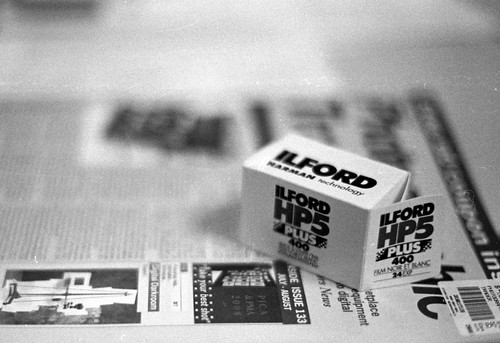
Now I never really understood the lure of film, until I started playing with it myself. I blame Harry, he gave me a Canon EOS 1000F film camera and some great advice. Since then, I have scoured eBay for all sorts of filmy goodness. Some can be seen below.

It is now turning into an obsession. These things are so cheap on eBay it is ridiculous. I think the Yashica MG-1 rangefinder was the most expensive so far at $35. The next on the list is a TLR. Maybe another Yashica or Rollie, something thats is medium format so I can play with 120 film.

What makes film photography so addictive? I don’t know. I know alot of other people love film and take some amazing photos with it. I can’t put my finger on what it is, maybe its the fact that it is more hands on. It is tactile, unlike digital. There seems to be a greater sense of satisfaction with film compared to digital. I find I take my time when taking photos using film. You don’t have that feeling of invincibility that digital seems to instill in people. Its like my “What the Duck” mug says, “Shoot like hell, hope one sticks”. I don’t do that normally, let alone on film which is actually costing you every shutter activation.

Film is not for everyone. I expect Gen Y kiddies would hate it. But for people willing to give it a go, I highly recommend it. Grab a $5 eBay special and throw some cheap film in it and have a go. After all, if you don’t like it, just sell the camera on eBay and put it down as a learning experience.

If you love film, lets hear why.

Street. The new black. Or is it?

The pavements of our large cities run amok with humanity. People, people, everywhere. Smiling, scowling, deep in thought, drugged to the eyeballs, you’ll see it all on the streets. The smell of sweat, cologne, fear and greed. The sounds of traffic, people on mobile phones, dogs barking and planes overhead. The touch of a smooth hand rail, your fellow commuters rubbing against you in a packed train, a slippery pavement after rain. Big cities give me sensory overload. It might be why I moved away from Sydney. There is too much happening. I can only imagine New York at rush hour. I have seen places like Athens, Bangkok and Hanoi at peak hour, and it blurs my brain.

(C) Vitek
(c) Vitek 2008

“Whats this got to do with photography?” I hear you ask. Well, this blog post is all about street photography. It seems to have become trendy the past few months on a lot of photography forums I visit. It is the new black!

The first time I really took any notice of street photography was when I watched the fantastic six part documentary, The Genius of photography and they featured Joel Meyerowitz who I found fascinating. I still don’t know why.

Now, I love street photography. It is raw and in your face a lot of the time. Its something I wish I could do, but just don’t have the guts to get out there in confront people. Part of me loves the photos, and part of me hates the invasion of privacy.

Which brings me to a question I keep asking myself when ever i think about street photography. The question of privacy. I know there are some that say anyone out in public is fair game, but I know for sure, if Bruce Gilden (see him in action here ) jammed a camera and flash 3 foot in front of my face, I wouldnt be all that pleased about it. Having said that, some of his photos are fantastic.

I am also a huge fan of Joe Wigfall’s photography. Some of his photos are taken from the hip, which seems far less intimidating than Gildens method. Joe features in an excellent interview here on James Robinson Photography Blog, an excellent site for interviews of a wide range of photographers.

An example of Joe Wigall's excellent work.
(c) Joe Wigfall 2008

If I ever did manage to get into street photography a bit more, I would love to be able to produce the types of shots that Vitek takes. I love the way he uses light. He has an eye for detail. I just wish he hadn’t rubbed out a stack of his photos from Flickr.

There are plenty of other photographers who take fantastic street photos, who are your favourites? And what are your thoughts on the issue of privacy and the photographer?

Flashers, are you one?

For all those who wander the suburbs in a trench coat and nothing else, please go to the next Google search result, I am actually about to delve into the photographic world of flashers and their flashes.

A couple of years ago, I had never heard the term strobist before, but these days it seems every man and his glow worm are getting into off camera lighting. Apparently, the flash built in to most of todays cameras, is good only for blinding the unsuspecting portrait victim. Strobists seem to look down their noses at people who activate the flash and mush the shutter button. Unless you have got a couple of $5 second hand flashes, a few reflectors, an umbrella, a small notepad and 2B pencil, light stands, a soft box, a snoot, an assortment of coloured gels, a Fong whale tale and 1024 Eneloop batteries to create a second sun you just aren’t fair dinkum. According to David Hobby, over at http://strobist.blogspot.com/ “The site has over 230,000 regular readers, our discussion group has more than 30,000 members, and we are all about sharing ideas and techniques for small-flash lighting.” That is a lot of light getting pumped out.

Dust?
Macca flashes!

Now, I will say right now, I am not a strobist. I have a flash, that I haven’t a clue how to use properly, so it hardly ever goes onto the camera. I am sure if I had the inclination, I could probably work it out, and it may even improve my photos, but I don’t. Why? Well, I prefer to use available light. I like fast lenses. And I think strobists are your modern day trainspotters. Thats why I included the notepad and 2B pencil in the above inventory of your average strobist. Thats so they can document how they took the photo and include it in the Flickr descriptions. You will see things like.

“Strobist Info: Nikon SB-800 on 1/4 power left of camera, batteries at 15.8% capacity, through shoot-through reflector  and snooted using Pringles snoot. Topaz coloured gel on second SB-800 to right of camera, light stand extended to 61% of reach and pointed at 78.9 degrees to the model and ever so slightly upwards. “

Obviously, I have edited the description down, but you get the idea. Now whilst I am not a strobist, I love their passion. It seems once you go over to the strobist camp, you never come back. And the best thing about them, they seem to have a terrific sense of humour, are ingenious and take some damned fine photos.

Now back to the anti-strobists like myself. I have a feeling that natural lighting, or available light, whether it be natural from the bright round thing in the sky, or from man made light that isn’t a flash, seems to give a photo more atmosphere. I know, not all the time, but its my belief that most of the time it does. It might be more of a challenge, to try and get a photo with available light, although, after reading some of the strobist descriptions, they do take some time setting things up.

Happy Birthday Onz!

Using available light, see how sexy it looks  🙂

Which brings me to this weeks discussion point, are you a strobist? If not why not? if yes, what made you go over to the light side?

Photography, is it learned, or are you born with it?

It is not often that I change my opinion on something after speaking to someone for 15 minutes on any subject, let alone one that I am quite passionate about, but today, it happened. And I am not sure if i am happy about it or not.

I was invited out for a coffee with a local who is quite a big wheel in one of the local camera clubs. I had never met him before, and I consider him to be quite the bohemian, judging by his photos and a couple of chats I have had with him on the phone. I have 2 mobile phones, one work, one personal, and the personal phone had the work number on redial in case I needed to get out with dignity.  As it turned out, he was a terrific bloke. He has been taking photos with all sorts of cameras for near enough to 40 years. He was interesting and obviously very smart. His name is Bruno.

The premise for the meeting was to talk about my entries in a recent competition at the camera club. Bruno has been putting pressure on me for a few months now to take an active part in the club. I’m not the most social bloke in the world, and sitting around critiquing other peoples photos isn’t exactly my idea of a good night out. I would much rather be out and about taking them. Also, sitting around with people with 40 years experience sort of intimidates me. I don’t know much about the famous photos or photographers, and what I do know, doesn’t impress me a great deal.

Then we got to talking about good photos, and who takes them. I had, up until this morning, always thought it was something you could learn. You know, don’t cut off heads, try and get horizons right, stuff like that. Bruno is of the opinion, and I have to say he made a bloody good arguement about it, that people have either got a good eye for photography, or they don’t. My arguement was based around people going to university, art school or night school to learn how to take good photos. Well, Bruno took that point of view and wiped the floor with it. Certainly, people can be trained to take good photos technically, but subject matter, compostion, understanding light and numerous other things are done more by instinct for the better photographers according to Bruno.

I have mentioned on Flickr and other sites that I have been told that I have a good eye, but that is from people that only see whats on Flickr. And that, I can say with some certainty is but a pinch of the photos that I actually take. I would estimate that 1 in 30 or 40 photos I take makes it on to Flickr. And that is the cream of the crop. The rest are rubbish. But after a few more minutes of chatting to Bruno, I think he has a point. He gave me a few photographers to look at, all very well credentialed, and told me to look at their photos, and see if I thought they took good photos. Five or the six I looked at, didn’t take very good photos, in my humble opinion anyway. They looked forced. Some looked like they had tried too hard to make a certain type of photograph, and failed.

So, now I would like to hear other peoples points of view. Lets have it.